
Photos: Matthias Horn
A strong ensemble evening, very entertaining, very pointed and also very funny.
It is at times uproariously funny and then again existentially futile.
Yana Ross' overwriting shows how timeless the text is at its core.
Press
- Berliner Zeitung ↗
- Der Tagesspiegel ↗
- nachtkritik.de ↗
- Deutschlandfunk Kultur
- rbbKultur
- Nathalie Eckstein, Theater der Zeit ↗
Team
- Direction
- Yana Ross
- Set
- Bettina Meyer
Cast
- Nicolas
- Peter Moltzen
- Sarah
- Constanze Becker
- Sasha
- Amelie Willberg
Read the press 2 reviews
Nathalie Eckstein, “Wie der Hummer im Kochtopf”, Theater der Zeit, 24 January 2023
As the curtain rises, Nicolas (Peter Moltzen) tries to kill himself at the “Netzroller” tennis club. He tests various possibilities and fails. He listens to an audiobook, “Am Beispiel des Hummers” by David Foster Wallace, a text that explores the question of a lobster's ability to suffer while it is thrown alive into the cooking pot and attempts to crawl up the walls and lift the lid.
The outcome of Ivanov is thus seemingly anticipated. The story captured in one image. The plot of Anton Chekhov's theatrical debut is well known: the ageing Ivanov (here he is called by his first name, Nicolas) falls in love with Sasha, the 21-year-old daughter of the man to whom he owes money, while his own wife, a Jewish woman who has broken with her parents because of him, is slowly dying of an incurable disease. The milieu is narrow, the boredom great.
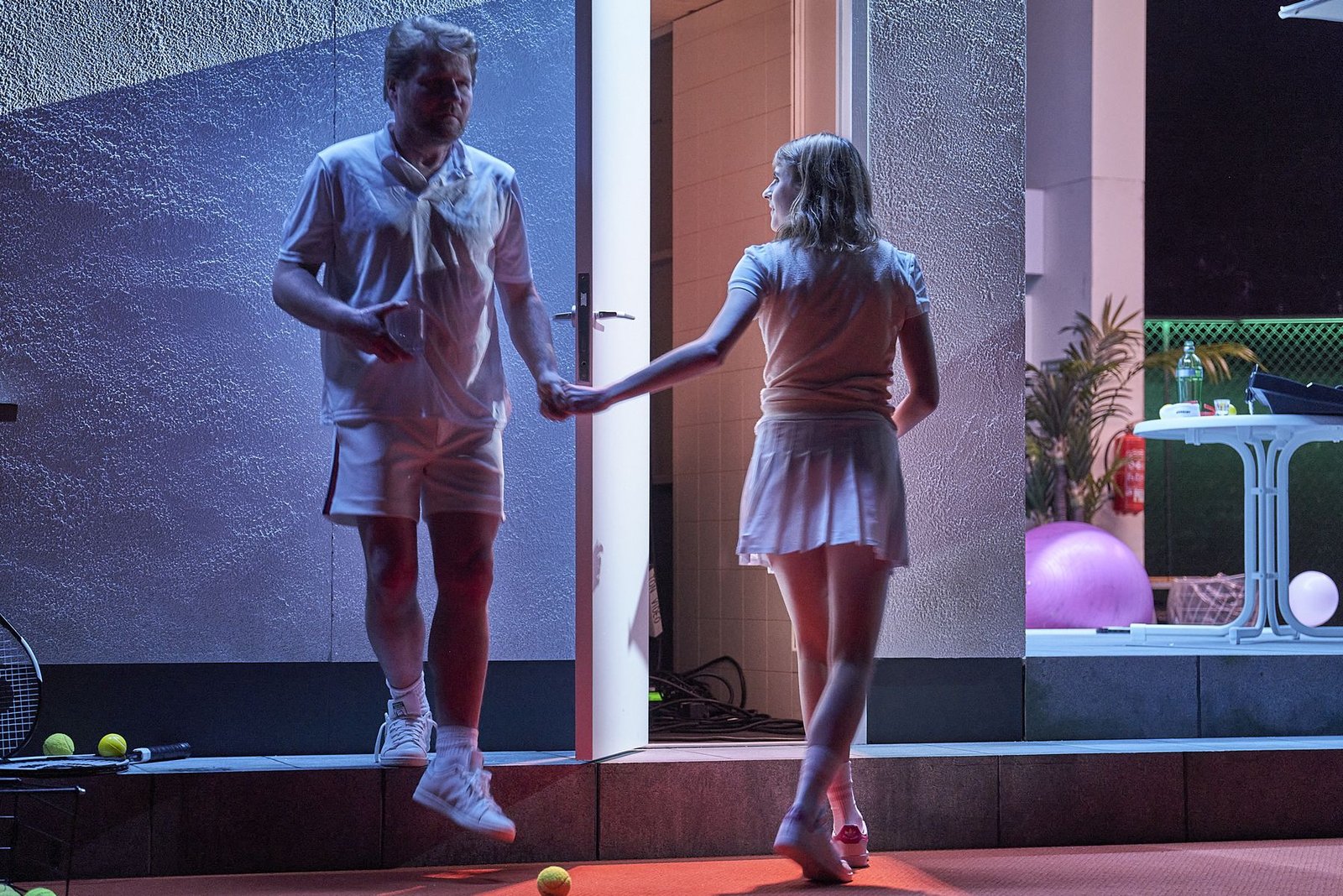
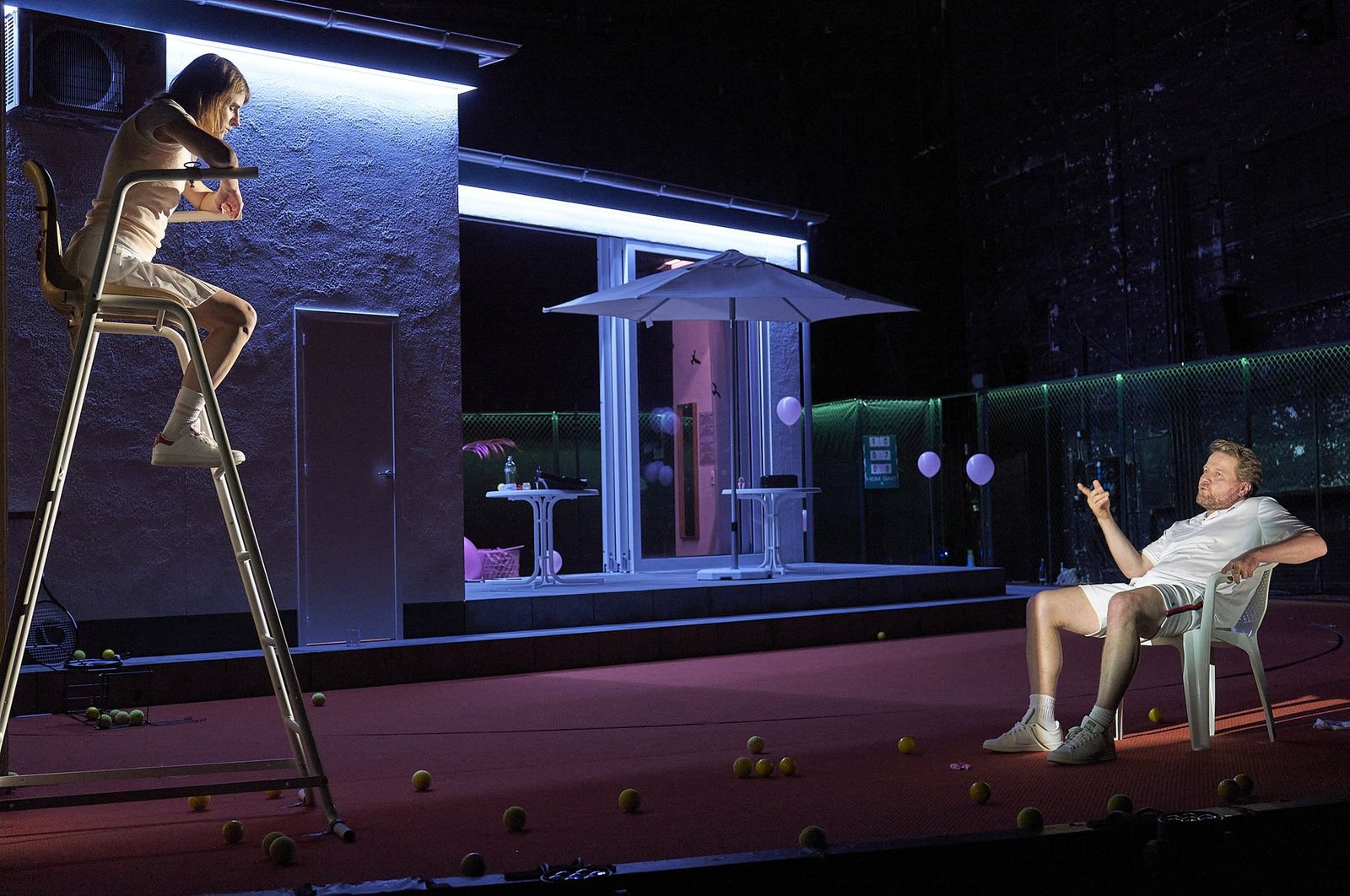
The decision to move the action to a tennis club works. Instead of the Russian province, the plot is programmatically set in Gütersloh. The middle-class milieu, which revolves exclusively around money and boredom, is full of prejudices and resentment. Tennis balls become weapons, like words. […]
Katrin Pauly, Berliner Morgenpost, 22 January 2023
The parties used to be wilder: Yana Ross relocates Chekhov's “Ivanov” to a Gütersloh tennis club at the Berliner Ensemble.
The “Netzroller” tennis club has seen better days. So have the people here. Like the clubhouse furniture, they are bumped here and there, worn and in parts only moderately functional. A disillusioned middle-class society meets here for a match that knows no winners. This match began, at least in theory, as early as 1887, when Anton Chekhov wrote his “Ivanov”. It was his first play. With her very free interpretation of “Ivanov”, Lithuanian-American director Yana Ross makes her debut at the Berliner Ensemble, where she will be working more regularly in future.
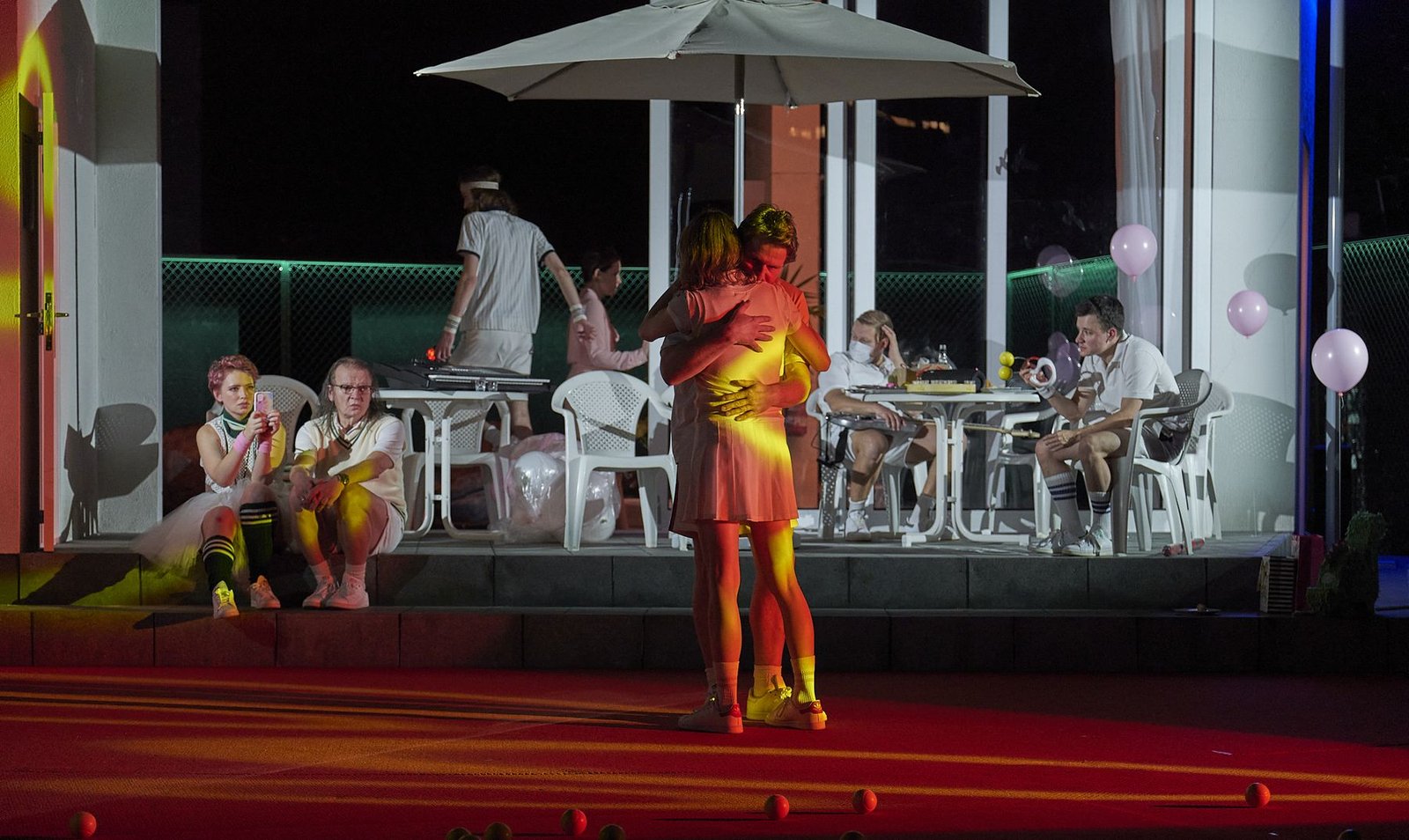
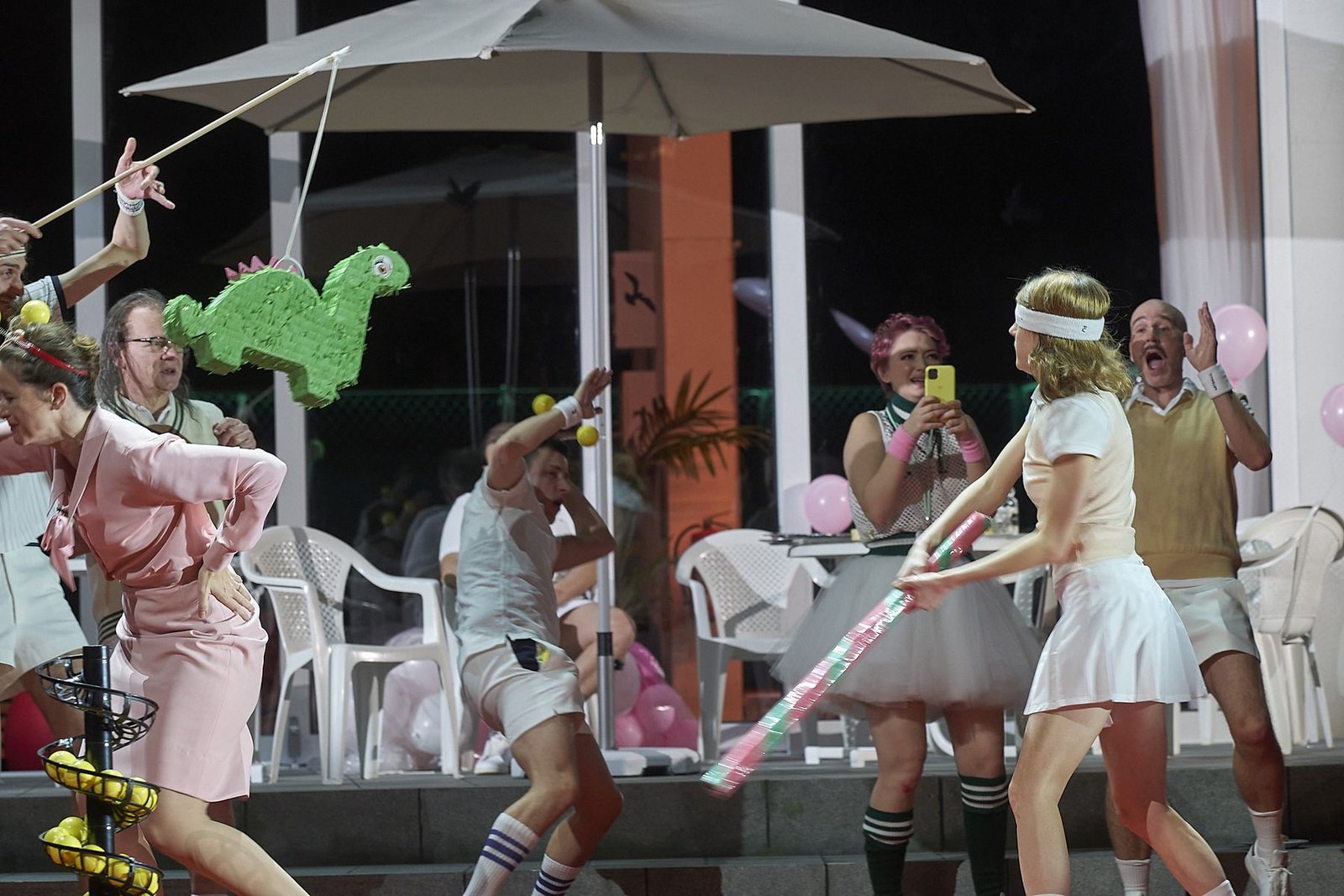
The director has brought the main features of Chekhov's drama completely into the present day and relocated a cast of ten from the Russian province to Gütersloh, to the aforementioned tennis club. The people here are now called Jürgen or Dirk, an influencer celebrates and feeds her 120,000 followers on Instagram between training sessions. People celebrate an altogether embarrassing birthday on the clubhouse terrace, there are anti-Semitic remarks, people discuss “violence in language” in a circle of chairs. The younger generation vacillates between annoyance and boredom, while the older generation thinks that the parties used to be really wild.
And in the middle of it all is Ivanov (Peter Moltzen), who is only called Nicolas here. Like Chekhov's hero, he has financial problems, which he represses, and a seriously ill wife. He no longer loves Sarah (Constanze Becker), as she is called, but at the same time feels remorseful about it. This doesn't stop young Sascha (Amelie Willberg) from aggressively throwing herself at him. We don't know why she does this: Nicolas suffers from knee, head and back pain, gets out of breath pretty quickly, is indecisive, snivelling and doesn't like himself very much. Incidentally, everyone here is pretty good at that: not getting on with themselves and others. This heats up the atmosphere on the court as a whole, and Yana Ross drives her ensemble into almost boulevardesque contortions, clearly looking for comedy, which is certainly present in the material, but unfortunately losing sight of the nuances.
Between drunken stumbles, crude jokes and funny party hair bands with bouncing tennis balls, the few more tender moments are almost lost. A few of them take place in the quiet of the changing room, in the togetherness of a dance, or when Constanze Becker sings beautifully and sadly. Otherwise, on the stage set up by Bettina Meyer as a tennis court with a revolving clubhouse on top, people bombard each other with words and often also with tennis balls for three hours almost without interruption. The ball attacks sometimes seem to trigger more (painful) feelings than the words. This is a bit unfortunate for an evening at the theatre.