Our Class
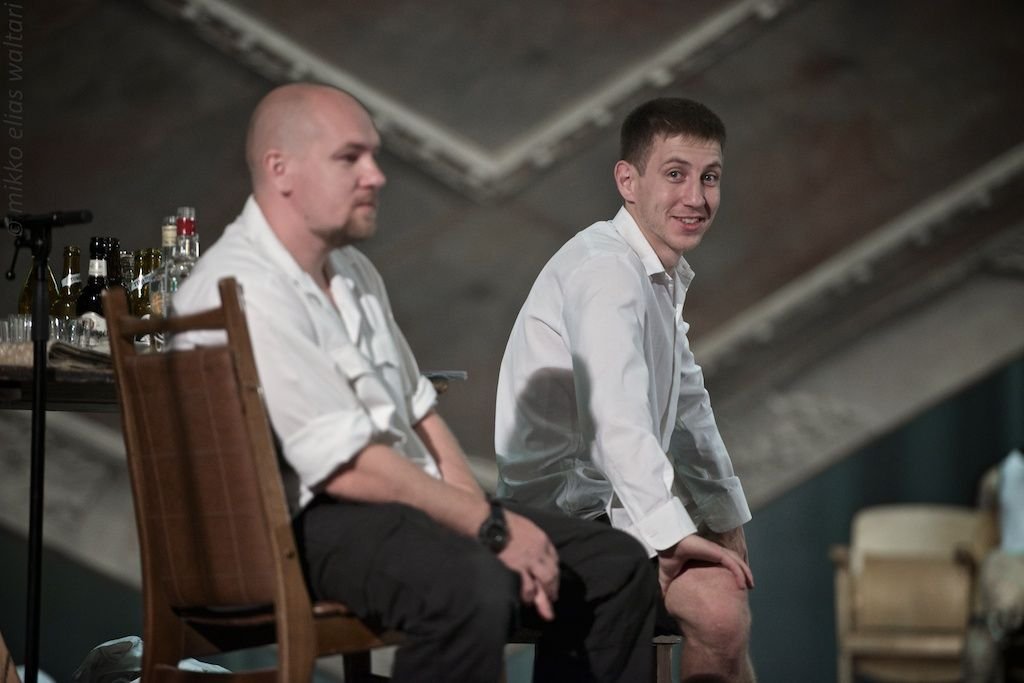
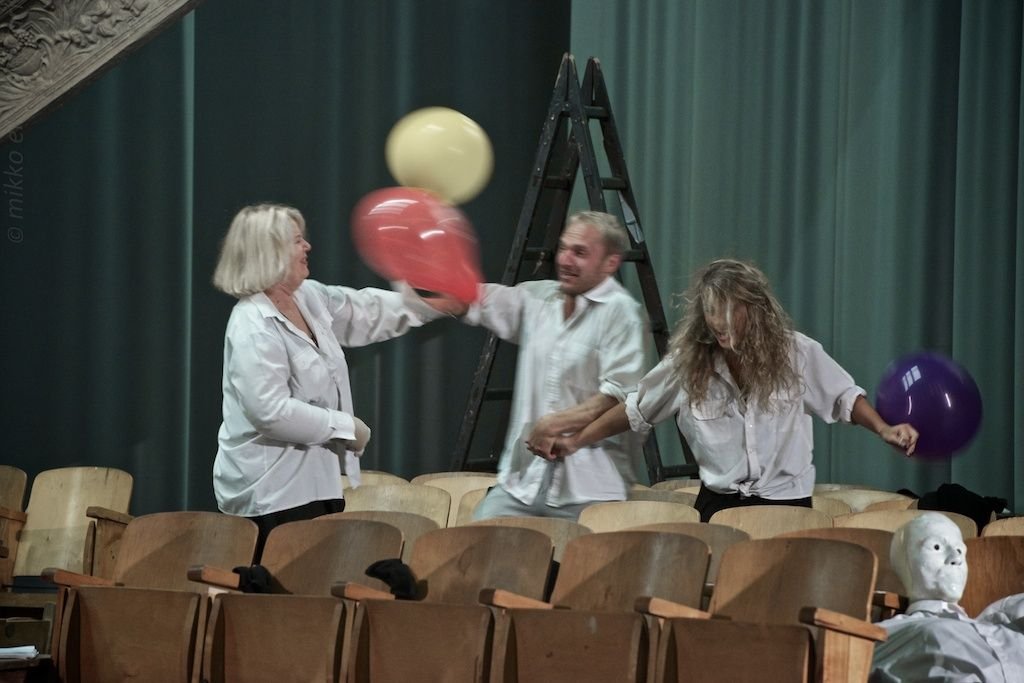
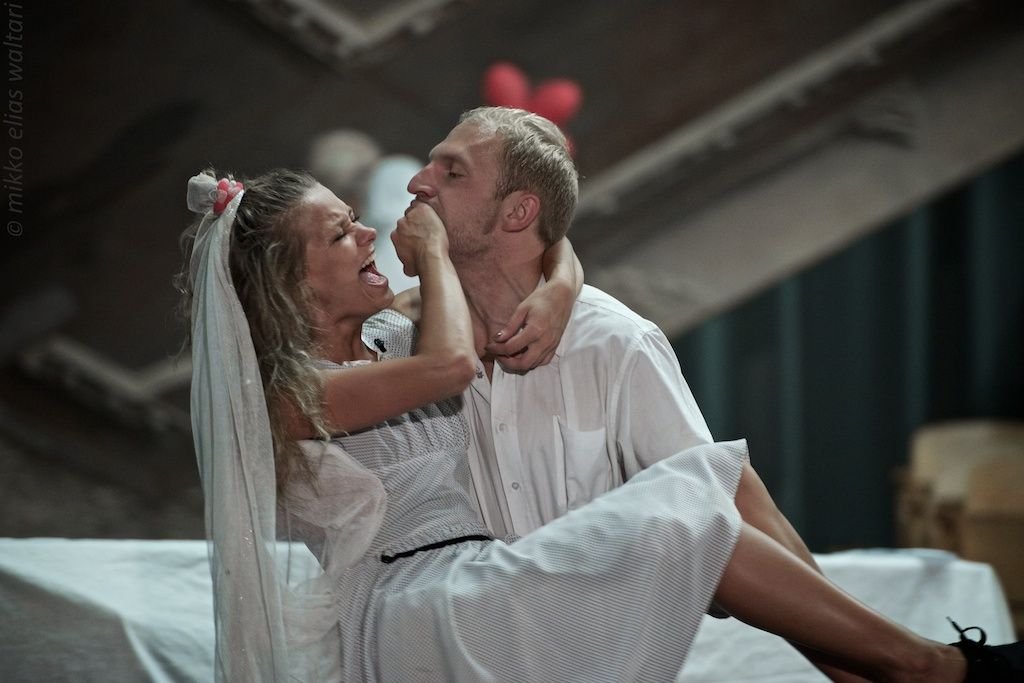
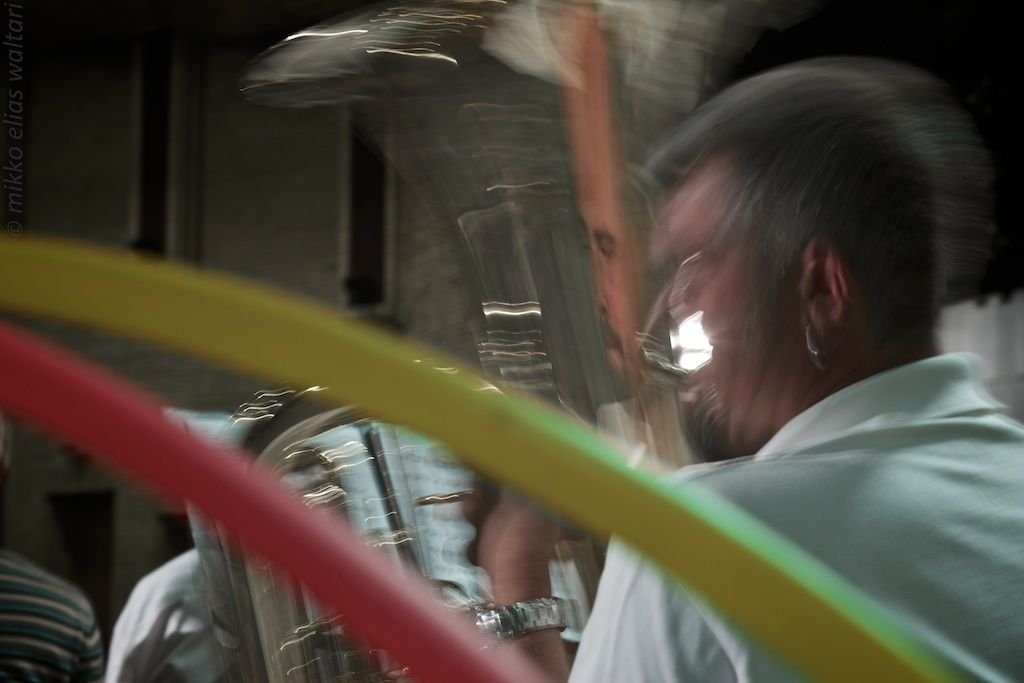
Although the play has been staged in Europe and North America, our production is addressed at the painful taboos of the present Lithuania. Performance is raising an urgent question of national collective memory and the aftermath of WWII. Ordinary daily heroism vs. betrayal and collaboration with Nazis during the war.
Our Class is based on real events taking place between 1925-2003; a small town neighbors are born, raised and murdered, trapped between Soviet and Nazi regime. The aftermath of a single day massacre haunts both living and dead in a brilliant dramatic interpretation by Tadeusz Słobodzianek, winner of the NIKE book prize 2010, the highest literary award in Poland.
The innocence of youth is overwhelming from the school bench to the first kiss, from a Catholic prayer to the first stone cast in the back of the “other.” The loss of innocence is tangible, it happens right before our eyes. Children become warriors and at the end of the game, their fragile bodies return to the state of childhood's immobility, lack of strength and lucidity.
Small town neighbors, Jews and Poles, face each other in sickness and in health, till death do them part. A story of a single town, a story of the nation and the whole race. Every human being is faced with a choice. What is the true face of human nature? Is our only tangible instinct to survive? Or to love? Love. Salvation. Faith. Choice. Our production focuses on humanity, the extreme circumstances call for strength of the human spirit, faith and compassion. The question is, do we still have it?
I have no doubt that this cry of Yana Ross’s raised Lithuanian theatre from the dead.
Ross created a visual masterpiece that overwhelmed audiences through sound, light and design.
The director does not dress this historical trauma in the classic garb of pathos, tragedy and pity. Rather, it is a mirror.
Team
- Direction
- Yana Ross
- Set
- Marijus Jacovskis
- Music
- Antanas Jasenka
- Video
- Eglė Eigirdaitė
- Light
- Vilius Vilutis
- Costume
- Zane Pihlstrom
Cast
- Dora
- Miglė Polikevičiūtė / Toma Vaškevičiūtė
- Zocha
- Rimantė Valiukaitė / Vaiva Mainelytė / Monika Bičiūnaitė
- Rachelka / Mariana
- Monika Vaičiulytė / Aldona Janušauskaitė
- Jokūbas Kacas
- Daumantas Ciunis
- Rysekas
- Dainius Jankauskas
- Menachemas
- Tadas Gryn
- Zigmuntas
- Ramūnas Cicėnas
- Henekas
- Paulius Tamolė / Gediminas Girdvainis
- Vladekas
- Algirdas Gradauskas / Tomas Žaibus / Valerijus Jevsejevas
- Abraomas
- Marius Repšys
Read the press 2 reviews
Łukasz Drewniak, “A Hole in the Sky”, Teatr, 2014, no. 5 (translated from Polish, via the Lithuanian version by Andrius Jevsejevas in Kultūros barai)
1.
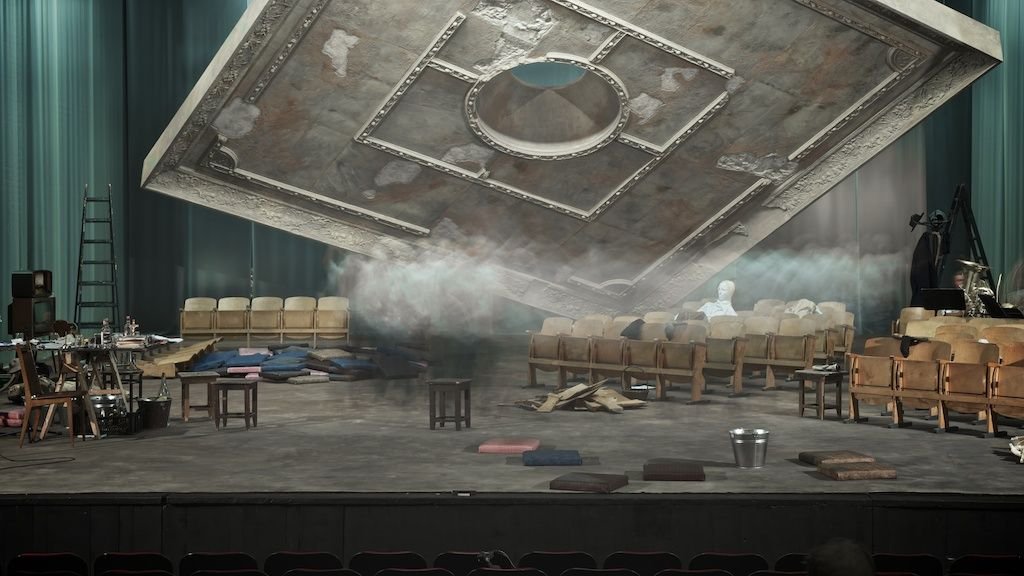
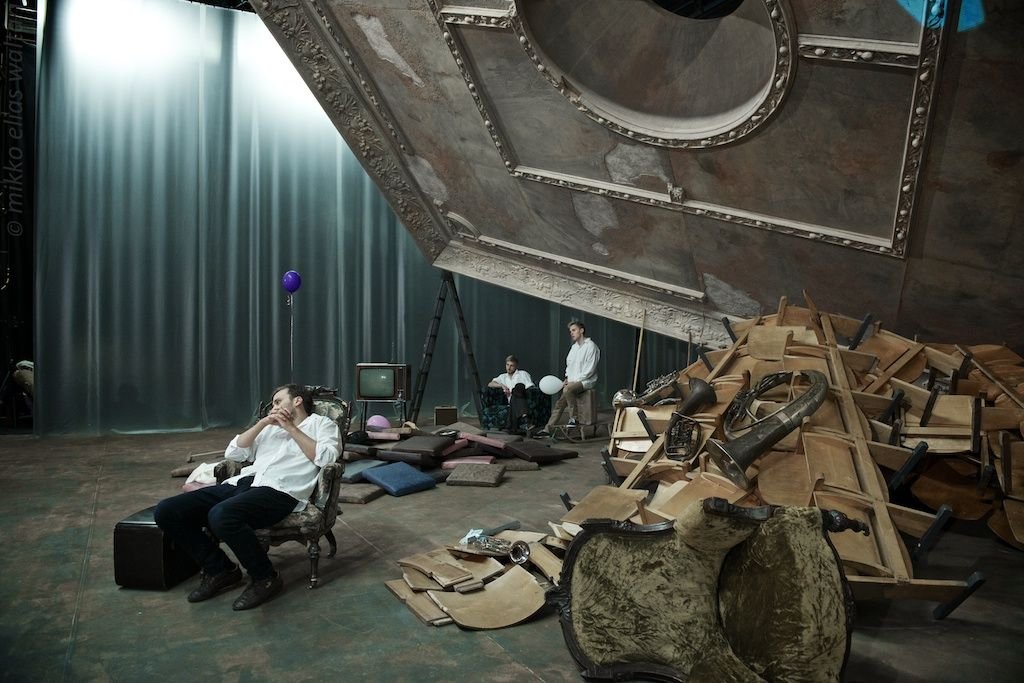
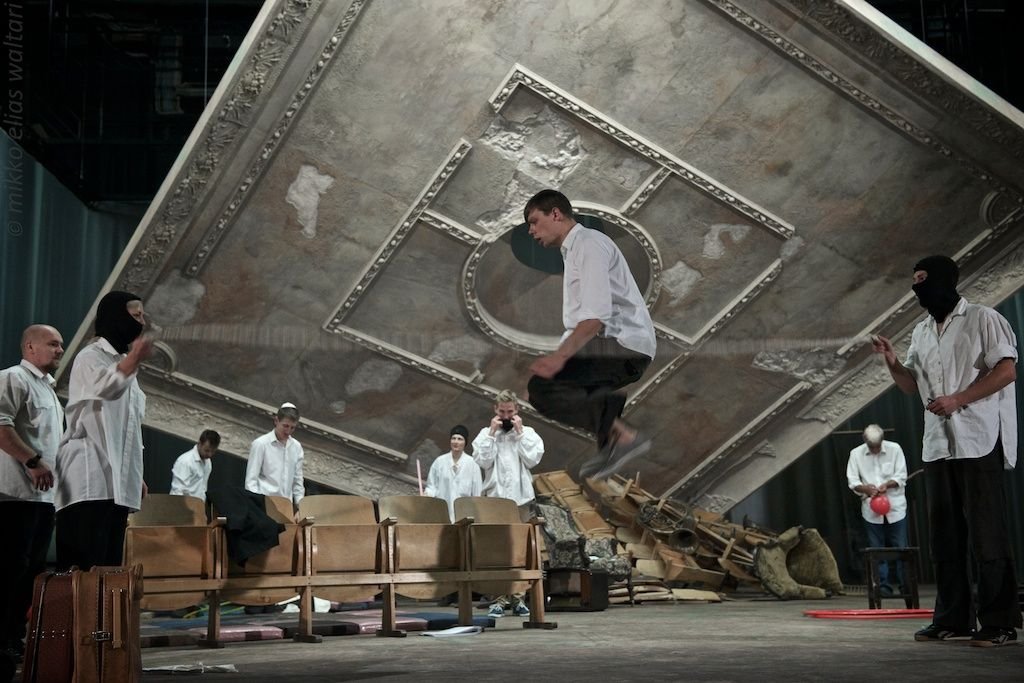
“They’ve turned the Catholic House into the Aurora cinema!” The space of Yana Ross’s Vilnius production grew out of these words from Tadeusz Słobodzianek’s Our Class, spoken in horror by Heniek, who will later become a priest. An ornate classical ceiling, with a round opening to let the light through, hangs above the stage as if it had fallen and been caught by invisible ropes. The collapsed ceiling has split the church, and with it split the whole world in two. The play takes place in a church, perhaps even a ruined cathedral, into which cinema seats have been carried. A renovation is under way that never ends; mattresses lie everywhere, ladders stand about, and buckets collect the rain. At the back of the stage, chairs thrown into a heap look like a sacrificial pyre ready to be lit. In Ross’s production no association comes free of consequence. The Lithuanian Our Class takes place in a sanctuary turned into a symbol.
Only last season, on the same stage, Oskaras Koršunovas staged Justinas Marcinkevičius’s legendary drama The Cathedral, about how the Lithuanians, as the First Republic was coming to an end, built a sanctuary as a symbol of life. Having lost their freedom, they still had their Ark. Later, in another production, The Bacchae, which argues with Koršunovas’s vision, Gintaras Varnas observed ironically that today’s Vilnius cathedral is no longer that historic temple: all that is left of it is a giant shopping centre called Akropolis.
Ross brings the symbol back once more. But this place has already been desecrated. For Słobodzianek’s play this means one thing: the community of “our class” did not begin to fall apart when the war started, when national and racial prejudice broke loose. The world split in two and collapsed much earlier, and the characters simply settled into the ruins. The former sanctuary becomes a cinema in which no films are shown, because everything that happens in this space becomes a theatrical film. The characters sit in the auditorium as if in a jury box, watching themselves in the past and the future, laughing, throwing out remarks, commenting. We hardly notice the sacrilegious decline of the cathedral as it happens: dances and weddings are held here, prisons and torture chambers appear. In the end the temple becomes the barn in Jedwabne in which the Jews are burned. A synagogue of fire.
2.
In Słobodzianek’s play the fates of “our class” are told by only ten characters. In the Lithuanian production a crowd comes onto the stage. Five musicians from some provincial brass band take their seats in the cinema, along with four senior actors (who play the characters who lived the longest) and, of course, the characters the playwright wrote. Ross pointedly ignores the chamber scale of the work; the intimate, mournful tone of the story does not interest her. This will not be a kaddish, a prayer of remembrance for the dead. None of the minimalism in design and acting that the author envisaged and preferred. From the very first moment the production is ruled by excess: of movement, of sound, of words. The director brings into play the whole staging machine that the world associates with Lithuanian theatre. She breaks individual scenes apart and draws at least two new ones out of each. She looks in the text for its essential images and makes them material on stage, even when they are images that cannot be shown directly. Instead of stating, she uses metaphor. Action replaces premonition; props replace rhythm. At times it may even seem that this is not one production but ten, each built on a different convention, on the same theme. Yet the threat of cacophony disappears, because Ross achieves an unusual aesthetic coherence, drawing on quotations, references, polemics, and a well-understood tone and atmosphere of Lithuanian productions made more than a decade ago. It is no accident that the visual design was entrusted to Marijus Jacovskis, son of Eimuntas Nekrošius’s first designer and Rimas Tuminas’s regular collaborator.
The Lithuanian Our Class was met with many accusations that one simply cannot tell the story of the Holocaust in this way: so bodily, so noisily, so youthfully, leaning on popular culture. The refusal of pathos was taken as a lack of respect. To tell how the Jews of the town were herded into a barn and burned, the makers of the production use tricks that seem to come out of Fellini’s films: bowler hats, balloons, loud music. The executioners, and the crowd that buries the charred bodies in a mass grave on German orders, pull on gas masks painted red, with donkey’s ears. This one prop takes in the Greek mask, the figures in Goya’s paintings, the comic Maus, even The Walking Dead. The destroyed community is symbolised by objects typical of Nekrošius’s theatre: spoons poured out of tin buckets. On the one hand they are things made by Jews, among which Rachelka/Marianna recognises her own. On the other hand they are the bodies of countless victims, silent objects trampled, scattered and gathered up again.
In the play itself, the crime, the christening, the engagement and the wedding festivities already form an organic ritual whole. It is not for nothing that Słobodzianek indicates that all this happens almost every day and every night. But for Yana Ross this is not enough. She goes further and strikes harder: before the massacre and after the wedding comes a sexual orgy. Everyone couples with everyone: ghosts with the living, victims with murderers. The crime loses its aura of menace and exceptionality, while the laughter and the merry pranks the actors play on stage are mixed with oneiric symbolism, where dream can no longer be told from reality. The audience is bombarded without pause by signs that contradict one another. The director breaks entirely with the author’s intentions: going beyond the conventions of narrative, she does not let the actors act out the story.
So what kind of event is the audience taking part in? One after another, the episodes of the play are joined by writing on the walls, scene titles, context, commentary. Ross expands some of the characters’ thoughts and explains their reactions and motives, as if writing notes in the margins, unable to keep silent while what is happening on stage happens. Songs play constantly, each one a hint of another reality, and each new era is marked by a new melody: when Abram Piekarz’s turn to speak comes, it is American; when the communists take power in the town, Soviet; later come Lithuanian pop songs and television-series themes. The audience reacts to these musical comments with smiles or with anger. Such juxtapositions shock Lithuanian viewers; they awaken something good in their hearts, and at the same time something not good.
And slowly we realise that Ross is not trying to tell the story of the Holocaust or to report on a forgotten pogrom, nor is she interested in the side story of a war that wrecked people’s lives. She speaks neither of the dramatic break-up of a once united community, nor of the symmetry of guilt, nor of fate’s due punishment for crimes. But if not of this, then what is this production about? What does the director need Słobodzianek and his play for?
3.
It is hard to be moved by this production, but just as hard to remain indifferent and keep one’s distance. Ross is looking for a theatrical language that can speak of annihilation while avoiding sentimentality, bitterness, pity, melodrama, tears. Shock gets you nowhere here. And the search for cold structures inside the tragedy seems to lead to a dead end too. The director chooses another strategy. She likes collisions; she combines elements that do not match: facts and conventions, text and image. Here the capitulation of symbols and their triumph are shown at the same time. A storm that breaks the stereotype that art is unable to tell of destruction. What matters is not how everything will be established, thought through or defined, but only to whom, when and by what means it is told.
And so the four old actors, until now extras wandering around the sanctuary-turned-cinema where a film about their lives is being shown, begin to tell for themselves how it was. Together with some piece of costume (a headscarf or a jacket), the young performers hand their roles over to them. At once the angle of vision changes. The whirl of events and conventions turns into a revision of what we have lived through and what we remember. It turns out that history and memory have in some incomprehensible way split and changed. The old saw something quite different, and differently, from the young. The emphasis falls on pathos and anger, a tone full of resignation: we do not know why what happened happened. Marianna, Zocha, Heniek and Władek know that a tragedy has befallen them, that in the past they made some essential gesture that decided their existence. But what was that gesture really? In the first part of the production their predecessors, the young actors, and we, the audience, still thought we knew. Now everything is quite different: we no longer take part in a provocative, pagan feast of fireworks, because what we saw is beside us, behind us, off to the side, gathered in the bodies and voices of these old people. Now all of it belongs only to them. And to no one else.
Abram Piekarz, who left for America before the war and so survived, has a special place on stage. From a certain point on he sits at a table piled with instruments, bottles and scraps of paper. Behind him stand an old television and an antiquated radio. It is from his table that the letters reach the other characters: a kind of Voice of America, an America that has no idea at all of what is going on over there in Europe. On stage Abram is a DJ, a witness, and sometimes even the playwright (he is played by one of the most gifted actors of the young generation, Marius Repšys). Abram does not age and does not die. For decades he stays just as innocent, childlike and naive. So I suppose that Ross does not believe in him. Abram is not a living person; he is only a myth his classmates want to believe in, a personified longing, the hope that one can escape fate, restore a murdered family, that the felled tree of life will grow again, spread its branches and cover every country and race in the world. Abram, the patriarch so to speak, writes to his classmates from paradise and from the grave. As soon as I read Słobodzianek’s play I sensed that something was wrong with this character, that some guilt attaches to him. After all, on a symbolic level it is precisely his departure that upsets the balance and destroys the brotherhood of the class. Reading the character this way, Ross shows the deceptive implausibility of the murder and the doubtful chance of salvation. At the end of the production Repšys stands in the middle of the stage and speaks in a quiet voice about his descendants, unable to stop, trying to talk us, the audience, round; he lies, he builds his own myth… Only stormy applause cuts the monologue short.
4.
About ten years ago Oskaras Koršunovas discovered Yana Ross in New York and talked her into coming to Lithuania to work at OKT. Even three seasons ago, when she staged Chaos in Vilnius, the director spoke a universal, European theatre language, as if she wanted to introduce Lithuanian audiences to other conventions. Now, having come to understand the local theatre, she has staged perhaps the best Lithuanian production since Koršunovas’s Miranda, or even since Nekrošius’s Shakespeare trilogy. In her hands the Lithuanian directing style came back to life and began to burst with meaning and emotion. And out of it, like a new current, flows a large, unexhausted theme that Lithuanian theatre had abandoned.
Before Our Class, the Holocaust had been addressed in Lithuanian theatre only in Joshua Sobol’s Ghetto (directed by Jonas Vaitkus) and Grigory Kanovich’s Smile on Us, Lord (directed by Rimas Tuminas). That is exactly why Ross’s production stirred up so many conservative viewers. It turns out that in Vilnius the Jewish–Lithuanian question can be raised, through a Polish play, by an American, “the daughter of cosmopolitan Russian-Jewish emigrants”, as internet portals began to call her after the premiere. Ross does not accuse Lithuanians of antisemitism or of killing Jews during the war, though she makes no attempt to hide that the production rests on the local context. Our Class is not set in Poland, and the events in Jedwabne are not compared either with the 1941 pogroms in Kaunas or with the killings at Paneriai, outside Vilnius. Ross knows that such a comparison would lead nowhere. So where does the “Lithuanianness” of this production lie? I think that for the director it matters to show what has not been shown. Theatre can pursue different aims, but first of all it makes it possible to show what is hidden, pushed aside, kept silent. In the production one senses the director’s reproach to Lithuanian theatre artists that they did not dare raise certain questions, that they gave up and withdrew from such an uncomfortable present. “Didn’t you want to talk about this, gentlemen?” Our Class shouts almost the whole time. “Were you looking for a tone, a text, approval? Why did you keep silent? You have a theatre language that can be used for exactly this. You only need to step away from private stories and the theatre classics.”
I have no doubt that this cry of Yana Ross’s raised Lithuanian theatre from the dead.
5.
In one of the first scenes of the second part, after the slaughter, the wedding and the orgies, Rachel, baptised as Marianna, clings to a white rope and climbs towards the opening in the centre of the ornate ceiling. She looks very much like the Virgin Mary rising into the night sky in Chagall’s famous painting. Still, it is only a metaphor, a visualisation of a thought of suicide, based on the character’s monologue. Ross shows it as a dream that tells us any escape, any withdrawal, is pointless. What is she running from? From Władek? From fate? Because there, in that Jewish heaven, a gentile executioner has already settled in too (through the hole in the sky pokes a head in a red-painted gas mask with donkey’s ears). Rachel hangs halfway: she does not want to return to earth, and she cannot rise, because even heaven has been taken from her. And then Ross creates an unusual video effect, projecting an exact copy of the ceiling onto the ceiling itself. The image covers the object; a phantom masks its true structure. Rachel hangs there and does not know whether she is still alive, whether she is dreaming, or whether she is already dead. Suddenly the stage picture trembles. For a moment phantom and object come apart, and the principle of the world’s deceptive surface is laid bare. In this tremor, this wandering between dream and reality that do not match, I see the first premise of Yana Ross’s production, its central theme. The Holocaust is the object, and the language of every art form, theatre, film, prose, becomes its phantom, trying to pursue it and to cover it. The greatest difficulty is to look for cracks in it. Yana Ross found them.
Bryce Lease, Theatre Journal
Ross, who has worked at the Berlin Volksbühne and the Finnish National Theatre, has brought a striking new directorial approach to the Lithuanian stage. Her production of Our Class differed from other recent premieres of the play in Poland and the UK in its use of live music, tragic-comedic tone, vibrant aesthetics and expressionistic lighting. Circus tricks replaced acts of violence and brutality, offering the audience a Brechtian distance between Ross’ lively and mischievous form and the explicitly tragic content. The younger members of the National’s ensemble performed the first part of the text, which focuses on Nazi-occupied Poland and the inauguration of Soviet-style communism, while older actors embodied more recent post-1989 history. The shifting of roles between younger and older actors evidenced the significant talent of an ensemble that work together with confidence and striking intimacy. Though some Lithuanian critics snubbed Ross for her unconventional treatment of Holocaust themes, the playwright Słobodzianek judged this to be the most successful treatment of Our Class to date.
Whereas productions of the play in Warsaw and London emphasized the language of the classmates’ memories, which move between testimonial and confession, by stripping back setting, props and visual cues, Ross created a visual masterpiece that overwhelmed audiences through sound, light and design. Although the play is set in Poland, Ross aimed specifically to highlight Lithuania’s position in the historical debates. Apart from rows of Soviet-era cinema seats – this type of seats has huge cultural resonance in Lithuania, where a production is said to be successful if the squeaking of these wooden chairs is not heard, meaning the audience is not restless but attentive – the main scenic element was a wall suspended precariously over the action, reflecting the pendulous weight of history which threatens to destroy the vulnerable community at any moment. At once suggestive of a circus top and a sacred monolith, the religious or transcendental impression the ceiling implies is furthered by a large central hole some reviewers compared to the ‘eye of God’. Ross observed that this ceiling functions like the ruins of history that continue to cling to spaces in which ideologies are in flux. ‘This,’ she claimed, ‘is Lithuania in the twentieth century.’ The long hanging walls that framed the stage action were at first take suggestive of crushed velvet, but appear to be made of mottled plastic when the light shines through them. The precariousness and instability of the stage surfaces chimes thematically with Słobodzianek’s examination of the instability and volatility of official monumental histories that sustain national mythologies and witness accounts that are a touchstone for Holocaust memorialization. As each classmate is introduced their lifespan is projected on black panels, reminiscent of a schoolroom chalkboard. The play unfolds in chronological order, and Ross’ decision to make us aware of the classmates’ approaching deaths increases the dramatic tension. Abram, a Jewish classmate who survives the Holocaust by immigrating to America, creates a live archive on stage as he obsessively records his classmates’ dialogues. However, the documentation of the historical archive through digital technologies such as video and sound recordings that Abram retouches, edits or manipulates further destabilizes claims to objectivity. Nostalgia also intervenes heavily into our understandings of memory: Abram’s letters from New York to Poland are accompanied by evocative American jazz that pointed towards the rhythm of Jewish life in the United States, which contrasted poignantly with the concurrent suffering of Polish Jews.
Słobodzianek has consistently stressed that his play is not a documentary, nor does it make claims to historical accuracy. Employing archetypes of Polish Romantic drama and Tadeusz Kantor’s ‘Theatre of Death’, the playwright was interested in revealing the ideological mechanisms obscured in everyday life that trigger contexts for suffering, atrocity and revenge. Privileging a sober intellectual theatre, Ross views actors as intelligent agents who should not persuade the audience through empathy or reassure them into a ‘lullaby feeling’. Rather, the actor’s role is to rouse spectators, to activate them as thinking citizens. The oversaturation of theatrical effects, in which a number of critics recognized the influence of German theatre on the director, was a deliberate attempt to eschew closure, a singular aesthetic means of representation and final catharsis.
One of the most significant stage signs was the use of silver spoons, which first signified the humiliating and inane labor the Jews were forced to carry out – the spoons are used by Jewish classmates as utensils to clean the town square – and later, after the burning of the barn, the spoons came to represent the bodies of the Jews themselves. When the spoons are poured out from buckets onto the stage the sound is like broken glass, a dim reminder of Kristallnacht. At a particularly memorable moment towards the conclusion of the play, Heniek, now an old man, burns letters and photographs from his life in a small bucket, and then throws himself among the spoons that litter the stage. When he stands up with great effort the spoons continue to stick to his body, reminiscent of the mannequins in Tadeusz Kantor’s Dead Class that cling to the living actors. Also reminiscent of Kantor, Ross does not shy away from the pleasure of violence and cruelty. Moments of severe brutality were rendered as circus tricks, and a stuffed dummy was used to double the body of victims being raped or beaten, marking the distinction between the two bodies (the actor and the dummy) as the distinction between the event and its traumatic return. The live actor watching the violence being inflicted on the dummy ‘in their place’ makes for a provocative comment on trauma, the ‘out of body’ experience victims of trauma often describe, maintaining the notion that trauma is not present in the original event but only in its return.
Ross’ most significant and provocative intervention into the text was the staging of the barn burning. In most productions, this is treated with quiet sanctity and a stripped-down scenography that is focused on the actor’s voice. Calling upon the circus theme, Ross staged the march of the Jews into the barn as a colorful and joyous parade with vibrant music, like the haunting grand parade in Dead Class. Surgical masks are donned when the bodies of the Jews have to be cleaned, and a military hat is passed around when the Poles are forced by the Austrian Amtskommandant to empty their pockets and give back the gold teeth they stole from the victims’ bodies, an act suggestive of the collection in a Catholic mass. While one Lithuanian critic pointed out the disorientation produced by this clash of content and form, what this change of genre points to is precisely the inability of the theatre to properly represent the Holocaust.
Although audience members might have been anticipating what Ross refers to as the ‘accepted stencil memorial to the Holocaust,’ the production did not establish the Shoah as a moment of historical exceptionalism, but rather placed it beside recent atrocities such as the civil war currently being fought in Syria and the Yugoslav Wars of the 1990s. The Lithuanian premiere was preceded by a public forum on ‘Art and the Holocaust’, attended by the playwright, director, as well as German and Lithuanian critics, where the relationship between historical trauma and the crisis of representation was hotly debated. One audience member complained about the treatment of the Jewish repatriation to Israel, which was rendered as a comic dance with the Soviet cartoon Chunga Changa, in which African children sing the praises of a plentiful new country where life is trouble-free and effortless. Notably, on the night of the premiere many audience members clapped along to the familiar melody with a nostalgic smile. While the spectator complained that this made an anti-Semitic parallel between Jews and monkeys, Ross observed that the man had confused the black children in the cartoon with animals, thus revealing the latent racism at work in the objection. This unintentional confusion highlighted more than any other the ongoing legacies of anti-Semitism and xenophobia in the country that the play brings to light.