abgrund
Photos: Ola Kjelbye
Not only the theatre experience of the year, but of the decade.
Yana Ross finds an exactly contemporary tone … and lets the direction take pleasure in heightening the roles almost in the manner of Molière.
A performance carried by anger, a kind of stage art one is seldom exposed to in a Swedish auditorium. Not necessarily comfortable, but much needed.
Team
- Direction & video
- Yana Ross
- Set & costume
- Zane Pihlström
- Choreography
- Mia Hellberg
- Music & sound
- Jonas Redig
- Light
- Magnus Svelin, Dainius Urbonis
- Make-up
- Ingela Collin
- Dramaturgy
- Anna Berg
- Translation
- Marc Matthiesen
Cast
- Sanna
- Mia Höglund-Melin / Caroline Söderström
- Kristoffer
- Mattias Nordkvist / Jesper Söderblom
- Frida
- Hannah Alem Davidson / Nora Sadayo
- Stefan
- Johan Gry / Ashkan Ghods
- Astrid and Gertrud
- Bibi Ejeby Söderblom / Astrid von Spreti / Saskia Medina Svanelid, Hedda Mårtenson Ghods
Read the press 6 reviews
Kai Martin, 27 October 2024 (translated from Swedish)
Superb theatre with the indiscreet charm and drama of the bourgeoisie
For a long time, perhaps even too long, Gothenburg City Theatre has drawn its bow without hitting the target particularly well. Sometimes wine, sometimes low water. But with “Skål för livet”, German-Swedish playwright Maja Zade’s play “Abgrund”, translated and adapted into Swedish for this very theatre, has become a staggering and utterly fantastic production.
Nothing here has been left to chance. With an effective and transparent way of working, director Yana Ross has got the ensemble to play at their very best without anyone having to show off. There is a lightness in the acting that charms and moves. It is dialogue that sounds as if the conversations were taking place not on a stage but in an everyday setting.
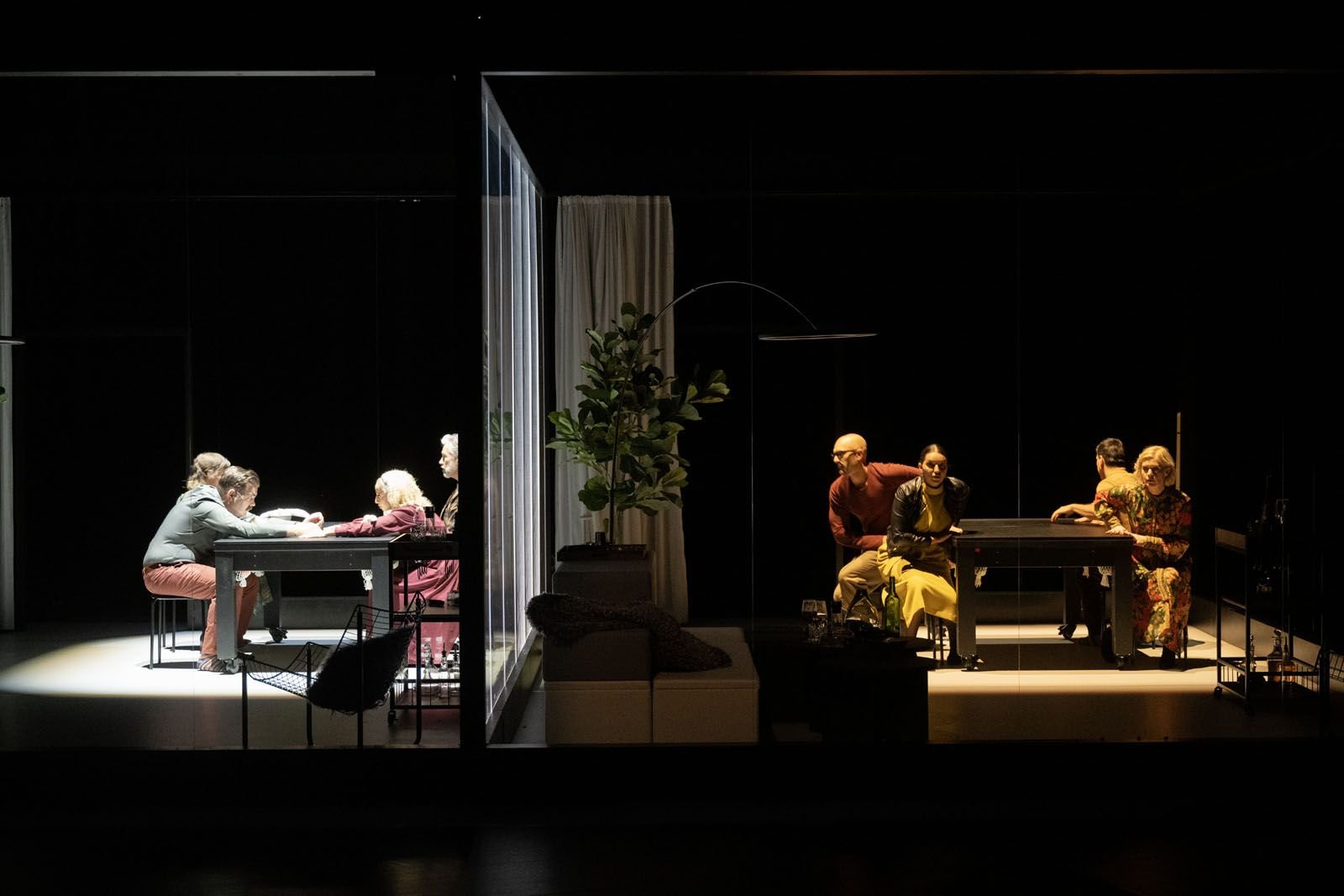
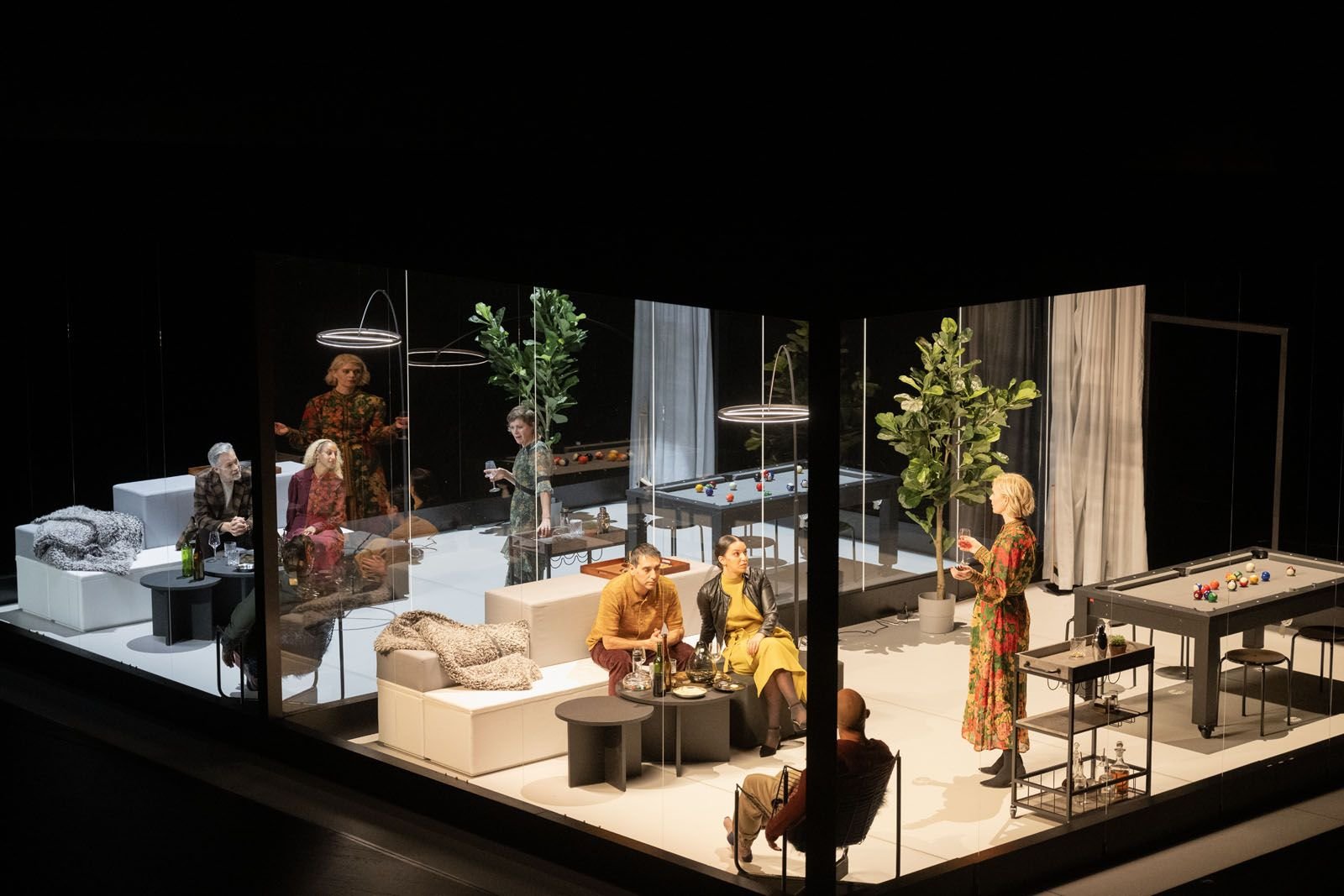
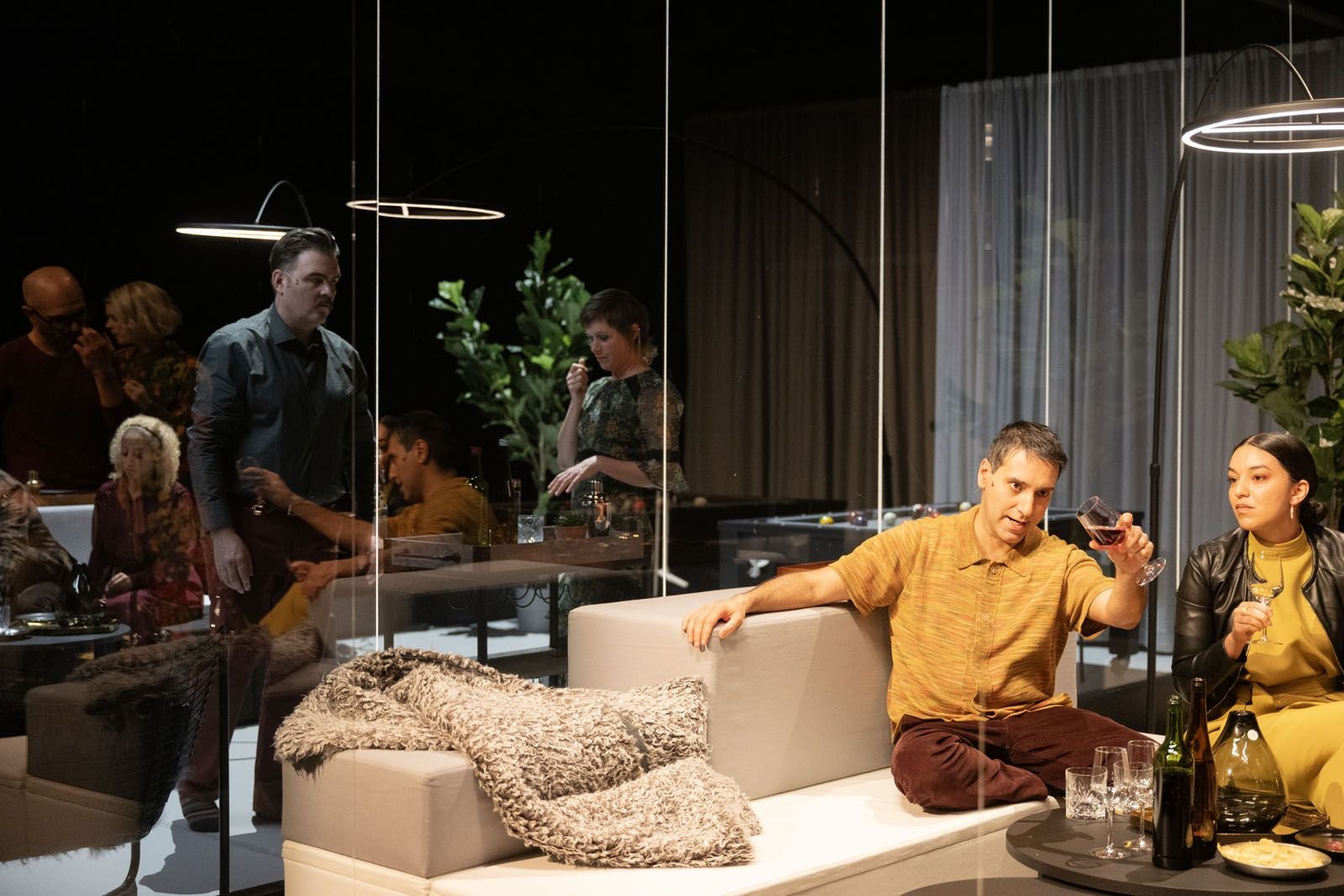
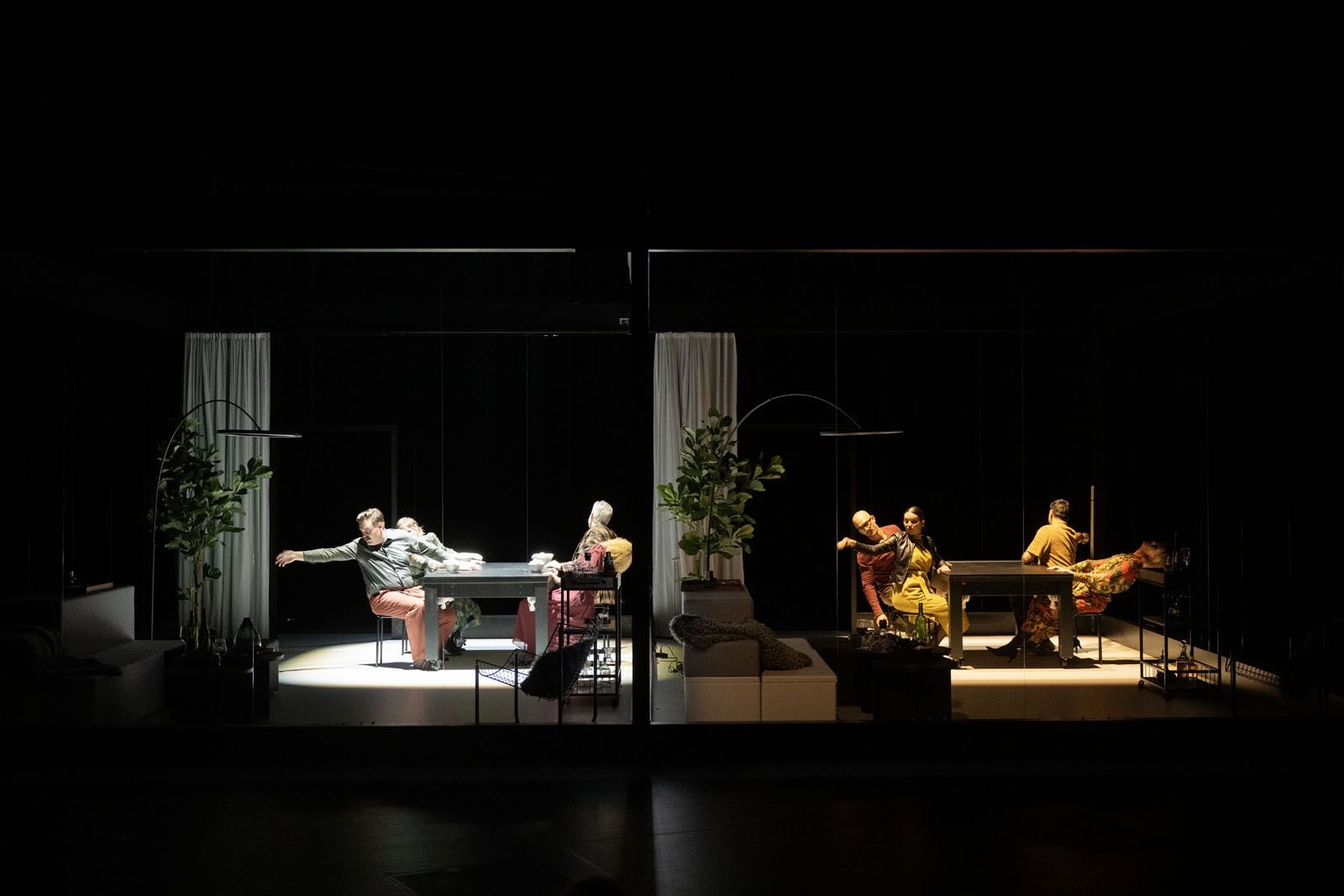
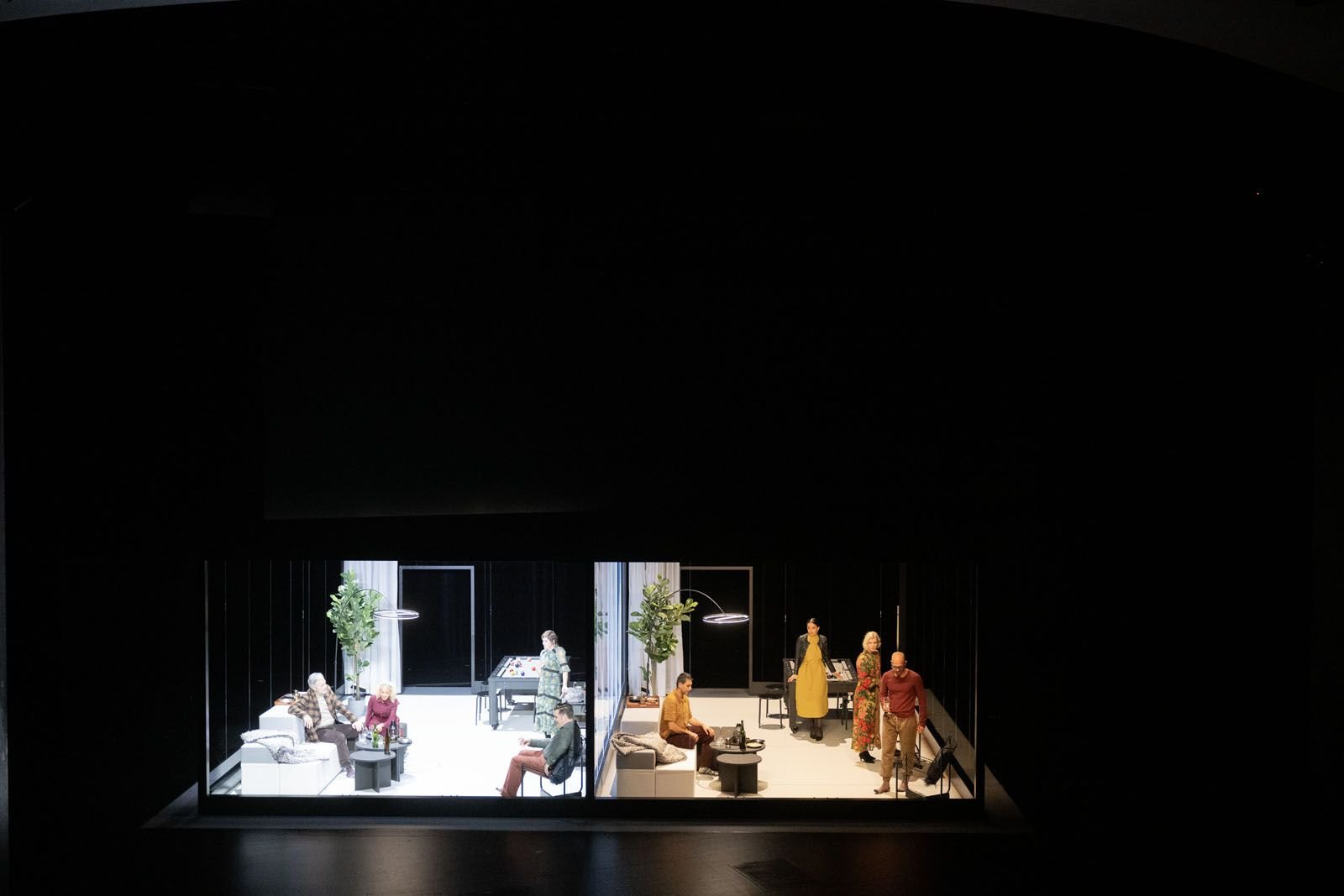
Zane Pihlström’s set is smart and tantalising. Two living rooms with identical furnishings, separated only by a reflecting, mirror-like glass wall – a wall the actors use with great skill.
Sound designer and composer Jonas Redig has created a sound that is astonishing and mind-expanding: crystal clear when required (the amplified sound of china and glass at the dinner table, for instance), or frayed, like a badly tuned radio station. Add to this the at times pantomimic acting, a choreography of the two quartets in the apartments that, in a tightly controlled play, draws out something serious.
Across the whole range it is both subtle and superb. Theatre art at its finest, a performance that dances away in humour and gravity for just over an hour and a half without an interval.
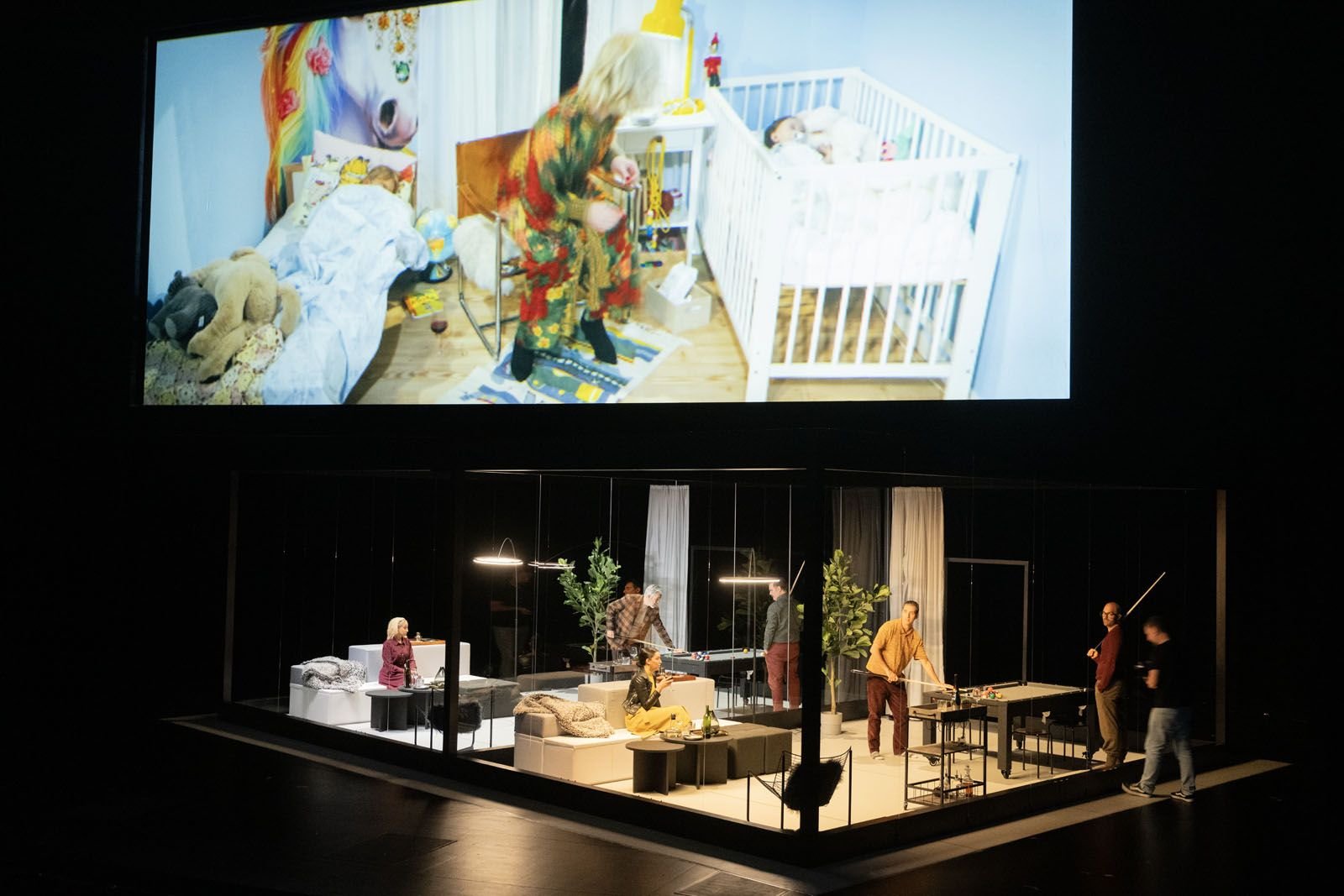
We meet a couple with two daughters – a baby and a five-year-old. The elder takes part on stage with great emphasis, and both appear in the videos from the nursery that complement what happens on stage. The couple have guests, a man and a woman; worldly people. There is eating, and above all drinking. The small talk is easy, humorous and lightly provocative. The discreet charm of the bourgeoisie in full light, with its sarcasm, friendliness and marital acidity laid bare. Together with the ensemble, Yana Ross and Anna Berg have adapted the script into an impressive here and now, in Gothenburg, with references to living on the city’s more prominent streets (Linné, Vasa, Avenyn). It is tremendously skilfully done.
As one notices, the quartets are reflections of each other. Same names, same lines, same movements, same events. But there are careful differences, with one group radiating greater loftiness than the other – something also shown in the colours of each group’s clothes.
But this is not just small talk in a bourgeois setting; it is, of course, also drama (the German title gives that away). The children end up at the centre, even though the parents would rather devote themselves to their party. The two ensembles seldom come together, but when they do – in a choral song and at a funeral – it is both unexpected and powerful. Just as unexpected, but more giggly, is when a sex scene escalates into group sex.
“Skål för livet” is a toast to the performing arts, to theatre and to modern drama. This is a play to see again and go on being delighted and amazed by.
Stefan Eklund, Borås Tidning, 28 October 2024 (translated from Swedish)
An impressive theatre machine carried by a strong anger
Suddenly the house lights come up, and the actors stand lined up at the edge of the stage looking at the audience, no longer protected by the darkness. The message is clear: this performance is about you.
And it is no flattering picture of the bourgeoisie who live in the inner city, drink expensive wines, shop at the market hall, boast about their travels – and go to the theatre.
The Swedish premiere of German-Swedish Maja Zade’s play “skål för livet” is a powerful theatre experience. When the play premiered at the famous Schaubühne Berlin in 2019 its title was “abgrund”, and that says more about what it is about: a superficial bourgeois life where consumption defines human worth, but where everything is balanced on an abyss of meaninglessness that not even a human catastrophe can shake.
The highly accomplished director Yana Ross has created a production in a brutal German spirit, in which Zane Pihlström’s set, a large glass box divided into two rooms, plays a major role, since the text’s dinner party is split into two parallel worlds. The same party, but two images of it, alternately lit and sounded, in an impressively precise way.
Now and then the actors leave the stage to check on the children, which is shown on a huge screen above the stage. Mia Hellberg’s choreography underlines the artificiality of the couples’ existence, and at times the performance moves towards the language of modern dance.
The eight actors are entirely at home in this hefty theatre machine, which surges forward for 90 minutes without an interval. Singling anyone out is impossible. It is ensemble playing by actors loyal to a directorial idea that reaches beyond traditional character acting and naturalistic theatre.
The dialogue, seemingly empty in a Norén-like way, flows efficiently. Not without humour, but the humour is pitch black.
There are also two children; what happens to them is crucial to the idea of the play. I will not reveal how.
“Skål för livet” is a merciless critique of an artificial life, in which anything that disturbs the privileged existence is perceived as a threat, even when it comes in the form of a child’s needs.
It is a performance carried by anger, a kind of stage art one is seldom exposed to in a Swedish auditorium. It is not necessarily comfortable, but it is much needed.
Lars Ring, Svenska Dagbladet, 28 October 2024 (translated from Swedish)
Here, abysses open beneath the social surface
In Maja Zade’s brutal parody of materialism and lifestyle hubris, facades and social codes crack when primal human instincts take over. At Gothenburg City Theatre the spotlight is turned on all of us.
It is now. A well-off, decent young couple invite their friends over to admire the new kitchen. They gossip and discuss – mostly things they are fairly sure they agree on. There are careful digs, and tensions between spouses sometimes cut through all the exquisite, very safe good taste that the wine and food represent.
Swedish-German Maja Zade’s “Abgrund” is called “skål för livet” (“cheers to life”) in Swedish, written in exactly that way, in lower case, as if to underline that this is an ironic morality play. Zade’s lines become platitudes that fall unthinkingly from the mouths of a generation born in the 1990s who have built solidly bourgeois surroundings where everyone inside can treat themselves to a good life: feel entitled to long flights, to inflated self-images and to their successful lives.
In one way the text recalls the dozen or so bourgeois quartets Lars Norén wrote in the 1980s. Dances of death about monster mothers, Electra complexes, addictions and involuntary childlessness. The big difference is the language. Zade’s text moves, as if deliberately, along the surface through platitudes, through a moderate, clichéd goodwill towards refugees, gay people and Jews.
The piece is a kind of farce that finally becomes a tragedy – or develops into utterly unthinkable events. As if a television broadcast had gone wrong and the picture turned askew. Facades and social codes are eaten up by primal human instincts; abysses open up beyond etiquette and civilisation. The varnish of language stays intact, but next to it we are shown images of a possible murder, of sexual orgies, of unfathomable grief. Something uncontrollable soils the new tiles. A vertigo.
I did not see the German premiere of Zade’s drama, staged in 2019 by the Schaubühne’s director Thomas Ostermeier, but assume that it too contained a doubling of the action. Two rooms with four actors each, side by side. At first everything seems to happen simultaneously, the lines and scenes mirror each other, but small shifts increase, events vary, as do subtle changes of character. It does not matter who says what.
[Lithuanian]-American director Yana Ross finds an exactly contemporary tone, a clear anchoring in Gothenburg, and lets the direction take pleasure in heightening the roles almost in the manner of Molière. Here stand 2 × 4 silly précieuses who do not realise that archaic mechanisms can destroy their lives.
The double quartets on stage play with the relaxed flow of a dinner party, with sudden jabs at those around them. Jesper Söderblom and Mattias Nordkvist share the role of Kristoffer, a smug cynic. Mia Höglund-Melin and Caroline Söderström play the wife, the woman who has no idea what extreme events her mask of well-meaning motherhood will lead to. Hannah Alem Davidson and Nora Sadayo, and Johan Gry and Ashkan Ghods, play smart, childless friends. All of them have listened with a fine ear to an insistent modernity.
Zade’s eventually brutal parody of materialism and lifestyle hubris has entirely classical roots, reaching back to antiquity – but it also makes me think of Ibsen, of “Little Eyolf”. Of an almost objectified child, an unseen project that suddenly creates an eternity of guilt.
“Skål för livet” begins as a comic chamber play. But Yana Ross, literally as well, turns the spotlight on all of us. In the end it does not matter who says what; the voices form a chorus in which reality, with its unpredictable inhumanity, smashes facades, games of pretence and life-lies.
Mats Hallberg, Kulturbloggen, 28 October 2024 (translated from Swedish)
The lusts and anguish of the upper middle class ingeniously exposed in a congenial staging
[…] That is why it is enormously liberating to witness the clever comic mirror of a script that Swedish-German playwright Maja Zade has constructed. Here we are spared categorical positions. Instead the director, and above all dramaturg Anna Berg and the ensemble, add piquant local colour and put forward the ideas and anecdotes that shape eight well-established individuals, four middle-aged couples. The only weakness concerns what makes the at times black humour turn into irreversible tragedy. The dramaturgy’s horrifying climax happens inside one of the families. It could be seen as a missed penalty not to let any of the four well-off couples, themselves or through acquaintances, be hit by burglary, fraud or violent crime. Perhaps the playwright is suggesting that these couples have been unusually lucky. Though surely it is only a matter of time before they are hit, despite their lives in their respective ivory towers.
In any case, my spontaneous feeling right after the curtain fell, after about an hour and a half (an unusually short running time for the main stage), is that the play – set in what the character Stefan (Johan Gry) considers the suitably fashionable Linné district – definitely belongs among the best things I have seen in the theatre building on Götaplatsen this century. I am stimulated by the lines and exchanges, the acting and the child’s perspective, the provocative set and the surreal shifts into slow-motion choreography and animal, primitive body language, which in one sequence turns into comically instinct-driven impulses. Movements probably there to show how thin the membrane can be between decent behaviour and irrational, uncontrollable needs – our longing for orgasm. Sometimes the conversations stop and turn into robot-like movements.
We get to experience peep-box theatre that is as illuminating as it is entertaining, whose double quartet inside the two glass boxes forms a kind of community of values, though rifts appear when opinions clash. The play’s bourgeois-minded and financially comfortable couples hold drawn-out dinner parties at the same time, wall to wall, with party games and excursions to the nursery. Under certain circumstances the hostesses can apparently see each other. On a couple of occasions the two parties come together, above all after the catastrophe has happened. The conversations of the two parties, with the men in remarkably everyday clothes, are played alternately. A couple of times the director lets cacophony break out as everyone talks over each other. Perhaps only seemingly, but the events in the glass box on the right appear to have slightly greater weight. In both gatherings there is billiards, and the friends hold engaged conversations that, in the translator’s words, reveal “cracks in the perfect meaninglessness”. Skål för livet premiered in Berlin in 2019.
The acclaimed Yana Ross is engaged for work with the whole world as her field. The Lithuanian-American director has staged Chekhov and Bulgakov in Sweden and adapted A Doll’s House in Gothenburg in 2018 in a fresh, innovative interpretation. I want to signal the gist of my descriptive praise: it comes down to how pleasurably enriching it was to take in a tragic comedy with hinted exaggerations, in a familiar manner, around the phenomenon of couples’ dinners. I realise that parodic elements, together with astonishing anecdotes and at times poisonous dialogue, are factors that keep the spectator from getting to know the characters in depth. Occasional risky lines make the listener uncomfortable, but Maja Zade is independent enough not to draw on the same source as Norén, Pinter, O’Neill and other anxiety-digging playwrights.
In Monsieur Venus the use of video was dismissed as a silly fashion in theatre. The City Theatre does not listen to that, and so the camera closely portrays scenes in the nurseries of both apartments. I am not sure whether these moving close-ups were recorded in advance or projected live, perhaps a mix. A little girl appears in the play, jumps outside the two-part glass box and addresses her mother. The device of giving us plot via a big screen works brilliantly, and the technology takes on a symbolic dimension in the finale. A downright brilliant aesthetic is practised in that a child of about seven reads the stage directions. Music has a surprisingly modest role, almost non-existent compared with the parties in Gatsby.
I laugh at many exchanges and comments. “You have to put up with a bit of squabbling, soon we won’t exist any more.” And a self-important host thinks striving for happiness is petty-bourgeois. High and low are discussed side by side, including taboos such as religion and politics. Funny, uptight positioning goes on throughout, always with an ironic grid. Johan Gry plays a person with a mild touch of know-it-all mentality, explaining terms and distinctions in the migration debate. The meta-waves run high a couple of times, especially when people’s interest in theatre is discussed. In one scene it gets even more curious when Kristoffer (Jesper Söderblom) brings up Returning to Reims, given that Söderblom, in its last act, together with the German team, started from himself and asked questions of the rest of the small ensemble in a production that became problematic at the end. Skål för livet contains a wealth of extremely witty references, plus a couple that fall into the category of gibberish, to mirror the self-confidence of these well-situated if deep down insecure individuals. Children and passing on a legacy are among the sore points.
Without a polished ensemble (fitted with radio mics) grounded in the beings they portray, the production would not have had the same effect. All of them are skilled at being part of a group while acting as independent personalities. The direction has successfully instilled the right rhythm in the production, an essential element. Through the security of the director’s far-sighted instructions, the right level of ease is added to the gathering, spiked with the text’s inevitable moments of discomfort, which must occur for drama to arise. Moments that sometimes seem realistic, sometimes unnaturally provocative. Though someone or some in both quartets actually seem to want to test and cross boundaries, above all the aforementioned Kristoffer and Stefan (Ashkan Ghods). We also get a somewhat closer relationship with the play’s two mothers, played by Mia Höglund-Melin and Caroline Söderström. Söderström moves with her nerve and never disappoints me. Nora Sadayo should have a bright future ahead; despite limited experience she already masters the craft.
I suspect that some of the lines spoken will come back to me now and then. There was so much devastating humour and animated conversation to ponder. A dazzlingly intelligent text! And I think it is fair to potential audiences not to reveal and discuss the play’s climax, which is marketed with the question of whether it ends in catastrophe. The premiere in Berlin was simply titled Abgrund. As with Monica’s Waltz, it left me wanting to see Skål för livet again.
Barbro Westling, Aftonbladet, 28 October 2024 (translated from Swedish)
Neatly arranged couples’ dinners with drink and group sex
In Maja Zade’s “Skål för livet” at Gothenburg City Theatre there is something mysterious beneath the polished surface
Two glass cubes, two identically furnished living rooms, a couples’ dinner in both. Outside, it is black. The evening has just begun and everything has been meticulously prepared. The two small children are asleep in another part of the apartment; the adults can talk freely and behave as they like.
And they talk and talk, about the stylish carafes at NK, an extra apartment as an investment, whether acupuncture really helps. Topics come and go but hardly leave a trace. The couples bicker a little among themselves, but without any real seriousness. The glasses are refilled, but the alcohol does not really make a difference either. As if to stress how little it matters what the characters say and do, the director presents them with robotic movements; then they play Twister and Crazy Eights and briefly engage in group sex.
The irony is that the couples make exactly the same gestures and behave exactly like the couples in the tasteful cube next door. Having “become like the others” is a theme both familiar and dear in these days when Kent are back in the news, but at Gothenburg City Theatre it comes minus the melancholy. Here it is the irony that is underlined with heavy strokes by the [Lithuanian]-American director Yana Ross.
It is today’s young bourgeois middle class that Swedish-German playwright Maja Zade lashes, and she counts on the audience feeling the hit. But the Teflon-like quality of the play’s language also creates distance. The phrasing is so expected, so without resistance, that the dialogue also tends to become indifferent despite the ensemble’s praiseworthy work. Everything is so perfect, no tears show in the fabric, still less can anything unspoken be sensed.
These children of the 1990s are so pleased with themselves, with how well they have arranged things for themselves, and how comfortable they can be at having done everything right and even holding the right, non-committal opinions about society at large.
For the audience, though, there is something else to ponder. A kind of physical mystery, for instance, beyond the choreographed elements that break the realism. The two women, each at her own dinner – do they really not see each other and are they not affected through the glass? The father who runs lap after lap in the dark and falls again and again. Why does he do that?
It is like a thriller, and yet not. It is like a nightmare, and yet not. Fragments are presented – shards from an aftermath? Over dinner the couples talk lightly about loving someone more than the others in the family, about Cain and Abel. Again the language, how those who speak believe they control reality and chatter on unsuspecting.
In ancient drama violence was never shown on stage, only spoken of. In “Skål för livet” it is not entirely clear what violence has occurred, and whether it pulls everything apart. Has the good child become the bad one? The girl standing there in her pyjamas asking for milk.
In Zade’s text there is a religious trace leading to the Bible and a kind of mother’s-milk mysticism amid all the linguistic high polish. In Yana Ross’s direction that trace glimmers through the scenically elegant whole, which is just so unimpeachably handsome. My less refined self, however, misses a nerve in the performance, and is not content with a lingering, quiet wonder.
Mikaela Blomqvist, Göteborgs-Posten, 28 October 2024 (translated from Swedish)
Chamber play without nuances
Same education, same amount of money. That is how the two couples in “Skål för livet” sum up what they have in common when they gather in an apartment in Linné to eat roast and make small talk about nothing.
The conversation is impersonal and empty: Why do you only ever hear about au pair girls and never au pair boys? What is the difference between making kimchi and making sauerkraut? Shouldn’t you have children too? How could anyone want to become a pathologist?
The [Lithuanian]-American director Yana Ross (who six years ago staged a sexually explicit “A Doll’s House” at the City Theatre) lets the drama play out in a hall. The set designer Zane Pihlström has placed a large glass box on stage and divided it down the middle into two impersonally furnished but identical living rooms. It soon turns out that the eight actors, evenly divided between the rooms, are also reflections of one another. Four at a time deliver the text, while the other four echo it through their movements.
Now and then all of them stiffen and begin to move like jumping jacks, while a child’s voice tells us what is happening. Video projections show visits to the nursery, where the two girls are the same but the actors and the events differ. Suddenly all eight gather in a corner and perform a short part-song about root-vegetable crisps and Chablis. On another occasion the dinner degenerates into a small orgy. Finally a catastrophe occurs – but only in one of the rooms.
In other words, it is about the upper middle class’s uniform preoccupation with surfaces and its unspeakable collective unconscious. The direction makes sure to underline this in every way. But isn’t the play itself rather superficial? Maja Zade’s text premiered at the Schaubühne in 2019, then titled “abgrund”, abyss. Its cheerful Swedish title captures it just as well. This is a performance that swings between extremes, without any nuances in between.
All the actors acquit themselves excellently. Not a single note rings false. But what good does it do when the lines are flatly realistic, identical to the ones you would be forced to listen to at a real dinner at the home of people you don’t particularly like? Perhaps it works in a German context, but in Sweden we have a long tradition of chamber plays, from Strindberg, via Bergman, to Norén.
The audience expects a certain elevation and, above all, substantial intellectual content. All of that is missing when the four roles are never more than types, middle-class people without history or future, entirely interchangeable. Nothing in particular happens between them on stage. The accident comes from outside. Nothing in the play as such leads up to it.
Despite the distance, “Skål för livet” also seems to imply a forced “we” that includes the spectator, something like: “Look how false our lives are! Really we want to have sex with and murder each other! Among our expensive designer furniture!” I don’t recognise myself, and – thank goodness – I don’t think others will either.